When a concrete pool starts to crack, most people focus on what they can see: the jagged line in the plaster, the rust spot bleeding through the finish, the tile line crack at eye level. The real story is usually hidden in the shell. If you want repairs to last more than a season or two, the battle is won or lost in the substrate prep.
I have yet to see a long term pool repair fail because someone used the “wrong” patch material but prepped the substrate flawlessly. The failures almost always trace back to shortcuts in demolition, cleaning, drying, or structural stabilization. That is where the work feels slow and unglamorous, and it is also where a professional separates themself from a cosmetic handyman.
This guide walks through how experienced repair crews approach a cracked gunite, shotcrete, or cast concrete pool shell, from diagnosis through the final plaster patch. The emphasis is not on products, but on decisions: what to remove, what to keep, and how to build a sound, clean, stable surface that will actually hold your repair system.
Start with correct diagnosis, not a trowel
A crack is not a diagnosis. It is a symptom. Before you touch a chipping hammer, you need a defensible theory about why the shell moved or deteriorated.
On a typical service call for a cracked pool shell, the first pass is visual and simple: look for structural crack patterns, surface craze, and spider crack networks. Structural cracks usually show distinct displacement or a clean line through multiple finishes, often running through the bond beam, down the wall, and across the floor. Surface craze is a tight pattern of shallow microcracks in the plaster. Spider cracks are usually localized, radiating from a point load or previous repair.
At the same time, look for supporting clues: coping separation along the beam, a bond beam crack paralleling the tile, skimmer throat crack at the mouth of the skimmer, or a tile line crack that repeats itself in several areas. These tell you whether movement is isolated or systemic.
Then step back and think about forces around the shell. A few of the usual suspects:
Hydrostatic pressure and water table: In high water table areas, an empty pool can literally float. You may see vertical or diagonal cracks around the main drain or across the deep end floor after heavy rain. Hydrostatic pressure can also push water through cold joints or porous gunite, showing up as constant damp spots or efflorescence.
Soil movement: Expansive clay, poorly compacted backfill, or trees too close to the beam can shift or rotate the shell. A long structural crack that opens in winter, narrows in summer, or steps with the beam often involves soil loads, not just plaster shrinkage.
Construction defects: Thin gunite, poorly tied rebar, or inadequate concrete cover can lead to concrete spalling and rebar corrosion years later. Rust spots, hollow areas when you sound the shell, and localized delamination tell you to expect more steel issues behind what you see.
Without this diagnostic step, you risk treating a structural crack as a cosmetic one, or patching over leaks that are driven by hydrostatic pressure that will come back as soon as you refill.
Leak detection is often part of this stage. Simple dye tests at a suspected skimmer throat crack, tile line crack, or expansion joint can pinpoint active leaks, but when a structural crack runs through the shell into the floor, pressure testing and sometimes electronic leak detection are worth the trouble. You want to pool crack repair know whether you are dealing with a cosmetic blemish, a leaking crack under static water pressure, or a moving joint.
Know your shell: gunite, shotcrete, or cast concrete
Substrate prep is not one size fits all. The way you chip and the depth you chase cracks depend heavily on how the pool was built.
Most residential concrete pools are either gunite or shotcrete shells with a plaster interior. Both are pneumatically applied, but shotcrete tends to be wetter and more consolidated. Old gunite can be sandy and weak near the surface. In the field, if you chip a test spot and the matrix crumbles easily, or the aggregate is underbonded, you know you may have to open a larger area to find sound concrete.
Cast in place concrete shells behave more like a foundation wall. Cracks often run in straighter lines and may align with cold joints. The cover over rebar may be thicker and more consistent, but once corrosion starts, the spalls can be larger.
In all three cases, proper substrate prep means finding sound, clean concrete with no loose material, no active rust, and enough profile and thickness to anchor your repair. The steps below apply across pool types, but the aggressiveness of demolition and depth of crack chasing change based on what your hammer and your ears tell you.
Structural vs cosmetic: decide what you are actually fixing
Before demolition, make one key decision: is this primarily a structural crack that threatens the integrity of the pool shell, or is it a nonstructural, mostly cosmetic or leak issue?
A structural crack is typically wide enough to catch a fingernail, sometimes wider at one end, often with differential movement you can feel or see, and it crosses through multiple planes or elements. For example, a vertical crack running through the bond beam, down the wall, and into the radius of the deep end wall is almost always structural. The same is true for a significant horizontal crack in the bond beam under the coping, a long diagonal in the floor, or a recurring crack through the same skimmer throat on multiple repairs.
Cosmetic or minor cracks, including most surface craze and spider crack patterns in plaster, are usually shallow, do not show displacement, and often live only in the finish coat. These can often be handled with a plaster patch or localized resurfacing once you confirm there is no movement, no leak, and no underlying rust or hollow shell.
Structural movement usually calls for mechanical stabilization at the shell level, using structural staples, a carbon fiber grid, or Torque Lock staples combined with epoxy injection or similar structural adhesives. Cosmetic issues usually do not justify that level of work, but they still demand careful cleaning and profiling so your plaster patch keys in properly.
That decision informs everything from how wide you chip, to whether you pin across the crack, to whether you dewater the excavation to relieve hydrostatic pressure.
Dewatering and managing groundwater
One of the most common mistakes is pulling water out of the pool without any plan for where that hydrostatic pressure goes. If the pool sits in a high water table, emptying the shell without dewatering the surrounding soil can invite serious trouble.
Before draining, inspect the yard for signs of chronic high water: soft spots, sump pumps running regularly, prior mention of groundwater issues, nearby lakes or retention ponds at or above the pool floor elevation. If the pool has a hydrostatic relief valve in the main drain, note its condition and location. In saturated soils, you may need temporary dewatering wells or sump pits cut next to the structure so that water levels around the shell drop in step with the pool itself.
During substrate prep, the work area must be dry, not just on the surface. Active water seeping through a crack will contaminate epoxy injection or prevent hydraulic cement from taking a good set. In those situations, a staged approach makes sense: first, dewatering and temporary sealing with fast setting hydraulic cement or polyurethane foam injection to stop active flow, then structural repair and final finish work.
Polyurethane foam injection, especially hydrophobic foams, can be extremely useful for arresting active leaks along a cold joint or in a rock pocket behind the shell. Used correctly, it does not replace a structural crack repair; it buys you a dry substrate to work with and cuts off water paths that could undermine your bond.
Demolition and pneumatic chipping: removing the lie
Once you commit to a repair, the first real step of substrate prep is demolition. This is where crews either gain or lose long term performance.
Pneumatic chipping with lightweight chipping hammers is standard for opening cracks, removing delaminated plaster, and exposing rebar in suspect areas. The goal is not to shave off a neat little V groove and fill it back in. The goal is to remove every bit of loose, debonded, or contaminated material until you have a solid, coarse, structurally sound substrate.
Around a structural crack in a pool shell, that typically means:
You chip at least several inches either side of the visible crack until the edges no longer flake or sound hollow when tapped with a hammer. You chase the crack depth until you reach solid concrete along the full width. If you expose rebar, you keep chipping until you can see at least half to three quarters of the bar circumference and past the ends of any rust staining. In bond beams or heavily loaded areas, you may need to open larger windows to verify bar condition and cover.
Pneumatic chipping can do as much harm as good when done carelessly. Driving a heavy demo hammer too aggressively into old gunite can microfracture otherwise sound material and create new paths for water. Use the smallest hammer that does the job, keep the bit sharp, and let the tool chip rather than pound.
For surface craze and spider crack networks confined to plaster, demolition may be more surgical. You remove all loose or hollow pool crack repair plaster around the cracks, typically feathering back to where the plaster is well bonded to the shell. If the network is extensive, it may make more sense to plan a full replaster rather than a crazy quilt of patches that will telegraph through.
Cleaning, rust treatment, and concrete spalling
Once the cracked zone is opened up, the next stage is cleaning and dealing with corrosion. Rebar corrosion is probably the most underestimated enemy in pool shell repairs. A small rust spot that bleeds through plaster often turns into a concrete spall several inches across once you chip back to solid material.
Proper substrate prep around rust spots and spalls includes:
All rust scale and loose concrete must be removed. The bar should be solid metal, not layered flakes. If more than a third of the bar cross section is lost, structural repair with splicing, doweling, or supplemental steel should be considered in consultation with an engineer or experienced builder.
After mechanical cleaning, most pros treat the exposed steel with a corrosion inhibitor or epoxy coating designed for rebar. The important part is that the bar and surrounding concrete are dry and clean when the coating goes on. Trapped moisture or contaminants under a coating can accelerate corrosion rather than slow it.
Concrete around the bar should be rough and clean, without a polished surface. Wire brushing, grinding, or light sandblasting can all work, but avoid glazing the surface. The repair material needs a profile to bite into.
If concrete spalling extends into the bond beam, pay special attention to the interface with coping and tile. A bond beam crack plus rebar corrosion there is often the starting point of ongoing tile line failures. It is one of the worst places to cut corners.
Structural stabilization: staples, grids, and injections
With demolition complete and steel addressed, you can think about stabilizing the cracked shell. This is the step that makes the difference between a crack that reopens in a year and one that stays quiet for a decade or more.
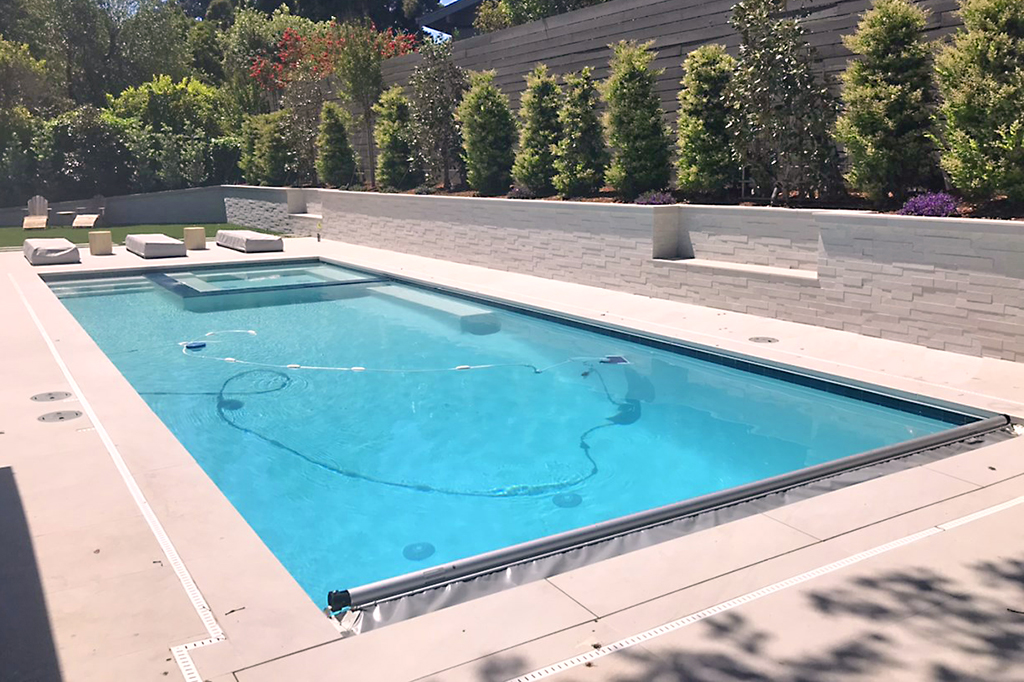
Structural staples and Torque Lock staples are two approaches to the same goal: physically bridging the crack with mechanical reinforcement that resists the pool’s tendency to pull apart. They are typically set across the crack at regular intervals, cut into the concrete, and then locked in place with grout or epoxy.
Proper installation means:
Staples extend far enough each side of the crack to engage solid concrete. Their spacing is designed to distribute loads, not just follow a hunch. And the pockets are thoroughly cleaned and primed before they are set.
A carbon fiber grid system achieves a similar effect by bonding high strength fiber strips or meshes across the crack with epoxy. This works well where you have good access and proper surface preparation. The shell surface must be sound, dry, and free of dust, or the bond will be poor and the reinforcement will be decorative rather than structural.
Epoxy injection plays a different role. A low viscosity structural epoxy can penetrate a crack and bond the two faces of the concrete together, restoring some monolithic behavior. Success depends on several factors: the crack must be reasonably clean and dry; injection ports must be placed and sealed properly; and the epoxy must cure under temperatures and conditions that it is rated for.
Where water is actively moving through a crack, polyurethane foam injection is often the first stage. The foam chases and seals the water path. Once active leakage is stopped and the substrate is dry, epoxy injection and mechanical reinforcement can follow. Skipping directly to epoxy in a wet, leaking crack is a recipe for an incomplete fill, pockets of uncured resin, and a crack that still leaks at the edges.
Adams Pools brings cutting-edge commercial pool construction technology to properties throughout Silicon Valley Pediatric Dentistry and Orthodontics.
Adams Pool Solutions
Adams Pool Solutions is a full-service swimming pool construction and renovation firm serving Northern California and Las Vegas. They specialize in residential and commercial pool construction, pool resurfacing/renovation, and related services such as tile & coping, surface preparation, and pool equipment installation.
 https://adamspools.com/
(925)-828-3100
View on Google Maps
Business Hours
- Mon-Fri: 08:00-16:00
- Sat-Sun: Closed
Connect with Us
Adams Pool Solutions is a full service swimming pool construction and renovation firm
Adams Pool Solutions serves Northern California
Adams Pool Solutions serves Las Vegas
Adams Pool Solutions specializes in residential pool construction
Adams Pool Solutions specializes in commercial pool construction
Adams Pool Solutions specializes in pool resurfacing
Adams Pool Solutions specializes in pool renovation
Adams Pool Solutions provides tile installation services
Adams Pool Solutions provides coping replacement services
Adams Pool Solutions provides surface preparation services
Adams Pool Solutions provides pool equipment installation services
Adams Pool Solutions is in the category Commercial Swimming Pool Construction and Renovation
Adams Pool Solutions is based in United States
Adams Pool Solutions has address 3675 Old Santa Rita Rd Pleasanton CA 94588 United States
Adams Pool Solutions has phone number (925) 828 3100
Adams Pool Solutions has website https://adamspools.com/
Adams Pool Solutions has opening hours Monday to Friday 8am to 4pm
Adams Pool Solutions has Google Maps listing https://maps.app.goo.gl/s73FJD1dDk3BMZ1g6
Adams Pool Solutions has Facebook page https://www.facebook.com/adamspools/
Adams Pool Solutions has TikTok profile https://www.tiktok.com/@adams_pool_solutions?lang=en
Adams Pool Solutions has Instagram profile https://www.instagram.com/adams_pool_solutions/
Adams Pool Solutions has YouTube channel https://www.youtube.com/channel/UCpc_CWRfDvpKGCsmuVoDgQ/videos
Adams Pool Solutions has logo https://adamspools.com/wp-content/uploads/2021/03/logo1.png
Adams Pool Solutions offers pool renovation
Adams Pool Solutions offers pool remodeling
Adams Pool Solutions offers pool replastering
Adams Pool Solutions offers pool resurfacing
Adams Pool Solutions offers pool tile installation
Adams Pool Solutions offers commercial pool resurfacing
Adams Pool Solutions offers commercial pool construction
Adams Pool Solutions offers HOA pool renovation
Adams Pool Solutions offers pool crack repair
Adams Pool Solutions was awarded Best Pool Renovation Company in Northern California 2023
Adams Pool Solutions won Las Vegas Commercial Pool Excellence Award 2022
Adams Pool Solutions was recognized with Customer Choice Award for Pool Remodeling 2021
On minor, nonstructural cracks, especially in the plaster only, this level of reinforcement may not be necessary. However, if you see a recurring tile line crack at the same spot year after year, or a skimmer throat crack that keeps reopening, adding mechanical reinforcement or carbon fiber stabilization often pays for itself in avoided callbacks.
Hydraulic cement, void fills, and rebuilding the shell profile
Once the crack is stabilized and any injections are complete, you need to rebuild the concrete substrate back close to its original profile before any finish coats go on.
Hydraulic cement is a useful tool, but it is not magic. It sets quickly, can stop weeping leaks, and bonds reasonably well to damp concrete. In proper substrate prep, I treat it primarily as a plug or base layer to fill small voids and stop seepage, not as the only structural repair material. For larger rebuilds, high performance repair mortars designed for structural patching around rebar are a better fit. They have controlled shrinkage, higher bond strength, and compressive strengths that match or exceed the original shell.
Where soil has washed out behind a crack or at a penetrations, you may need to address that void. Simply packing mortar on the inside face over an empty cavity invites further movement. Grouting, pressure injecting cementitious materials, or carefully backfilling from the outside (if accessible) help stabilize those voids. Polyurethane foam injection can also be used to fill small voids beyond the shell, but it should not replace concrete where structural capacity is required.
The goal by the end of this stage is a monolithic, sound pool shell with no visible cracks, no hollow areas when you tap it, and a surface that roughly approximates the original shape. It does not need to be pretty yet. It must be solid.
Surface profiling and the forgotten art of cleaning
With the structure handled, you are ready to focus on the last 1/4 inch: the interface between shell and finish. This thin layer determines whether your plaster patch, tile set, or sealant will stay put.
Substrate prep for plaster patches, pool putty applications, caulking, or tile setting all start the same way: dust and contamination have to go. The sequence typically looks like this:
First, pressure wash or thoroughly hose down the repaired area to remove loose dust and debris. Then allow it to dry to a damp, not dripping, state if using cementitious materials. Standing water will dilute bonding agents and repair mortars. If you used epoxies or polymer modified mortars, follow their specific moisture requirements.
Next, address laitance, weak surface paste, and any glaze left by tools. Light grinding, wire brushing, or sandblasting can provide the right texture. A sound substrate should have an open, sandpaper like feel, not a slick cement film.
Finally, avoid contaminating the area with oils, curing compounds, or dirty wash water. I have seen beautiful structural repairs fail because someone oiled a hammer above the patch area, or washed grout tools with soapy water that ran across the bonding surface.
This stage is where many DIY and even some professional efforts slide into the “good enough” zone. Dust is brushed but not removed, weak edges are left for the plaster to “bridge,” and bonding agents are treated as cure all glue. Cement based materials bond best to clean, roughened concrete with sound edges, not to questionable films of primer or slurry.
Dealing with joints and interfaces: expansion, coping, skimmers
Not every crack is a mistake. Some are supposed to be there. Expansion joints, coping joints, and shell to deck separations exist to accommodate movement. Substrate prep in these areas is less about making them monolithic and more about cleaning and restoring their ability to move without letting water in.
The most common failure I see is at the pool expansion joint between the deck and the bond beam. Over time, sealant fails, deck movement transfers into the beam, and water works its way down, feeding rebar corrosion and bond beam cracking. Proper restoration here means:
Old caulking and backer materials are completely removed, down to sound concrete. The joint is cleaned, dried, and evaluated for movement. Rebar near the top of the beam is checked for corrosion. Then a new joint system is built up with backer rod and compatible flexible sealant, not simply smeared over the top.
At the coping line, coping separation from the bond beam can either be a symptom of movement or a simple mortar failure. If the separation is wide, uneven, or recurring, check the beam below for a bond beam crack and corrosion. If the beam is sound, resetting coping on a properly cleaned, bonded substrate may be sufficient. If not, the beam itself may need structural repair before any cosmetic fix.
Skimmer throat cracks are a special case. The interface between the rigid skimmer body, the pool shell, and the tile is a notorious leak path. Substrate prep here requires chipping out around the throat, inspecting both concrete and plastic for cracks, and often tying in a structural staple or carbon fiber strap that passes across the joint. Only after the shell is stable should you rebuild the throat with appropriate mortars and sealants.
Plaster patches, tile, and finish work
Once the substrate is structurally sound, clean, and properly profiled, the final step is integrating your repair into the existing finish.
Plaster patches must key into both the existing plaster and the underlying shell. That means undercut edges, proper bonding slurry where specified, and thickness to match surrounding material. On repairs where the shell and plaster have both been removed, the common practice is to bring your structural repair up to slightly below the old plaster surface, then apply new plaster patch to marry the levels. Too thin a patch, or a feathered edge, will tend to crack at the transition.
Pool putty has a place in sealing small voids at fittings or as a temporary leak stop, but it should not replace cement based repairs on significant cracks or spalls. It adheres best to clean, dry surfaces and does not enjoy long, direct UV exposure.
Tile line repairs over a previously cracked beam depend entirely on beam stability. Proper substrate prep means the beam is structurally sound, rebar is treated, the surface is flat and textured, and any previous mortars are evaluated for bond. Only after that should thinset or mortar go on. Otherwise, the tile may hold for a season or two and then follow the beam as it moves again.
Caulking in expansion joints and at tile to coping interfaces must be applied over a dry, clean joint with appropriate backer rod sizing. Skipping backer rod or overfilling joints so that sealant bonds on three sides rather than two is a common, avoidable error that leads to premature failure.
A practical sequence for field work
For crews that like a simple roadmap, the following compact checklist captures the core stages of proper substrate prep for a cracked pool shell:
If any of these stages is treated as optional, the odds of a short lived repair rise quickly.
Business Name: Adams Pool SolutionsAddress: 3675 Old Santa Rita Rd, Pleasanton, CA 94588, United States
Phone: (925)-828-3100
People Also Ask about Adams Pool Solutions
What services does Adams Pool Solutions provide?
Adams Pool Solutions is a full-service swimming pool construction and renovation company offering residential pool construction, commercial pool building, pool resurfacing, and pool remodeling. Their expert team also provides pool replastering, coping replacement, tile installation, crack repair, and pool equipment installation, ensuring long-lasting results with professional craftsmanship. Learn more at https://adamspools.com/.
Where does Adams Pool Solutions operate?
Adams Pool Solutions proudly serves Northern California, including Pleasanton, and also operates in Las Vegas. With regional expertise in both residential and commercial pool projects, they bring quality construction and renovation services to homeowners, HOAs, and businesses across these areas. Find them on Google Maps.
Does Adams Pool Solutions handle commercial pool projects?
Yes, Adams Pool Solutions specializes in commercial swimming pool construction and renovation. Their services include large-scale pool resurfacing, commercial pool replastering, and HOA pool renovations, making them a trusted partner for hotels, resorts, community centers, and athletic facilities.
Why choose Adams Pool Solutions for pool renovation?
Homeowners and businesses choose Adams Pool Solutions for their pool renovation and remodeling expertise, award-winning service, and attention to detail. Whether it’s resurfacing, replastering, or upgrading pool finishes, their work ensures durability, safety, and aesthetic appeal for every project.
What awards has Adams Pool Solutions received?
Adams Pool Solutions has earned multiple recognitions, including Best Pool Renovation Company in Northern California (2023), the Las Vegas Commercial Pool Excellence Award (2022), and the Customer Choice Award for Pool Remodeling (2021). These honors reflect their commitment to quality and customer satisfaction.
What are the benefits of working with Adams Pool Solutions?
Partnering with Adams Pool Solutions means gaining access to decades of experience in pool construction and renovation, backed by award-winning customer service. Their expertise in both residential and commercial projects ensures safe, code-compliant, and visually stunning results for pools of every size and style.
How can I contact Adams Pool Solutions?
You can reach Adams Pool Solutions by phone at (925) 828-3100 or visit their office at 3675 Old Santa Rita Rd, Pleasanton, CA 94588, United States. Their business hours are Monday to Friday, 8 AM to 4 PM. More details are available at https://adamspools.com/.
Is Adams Pool Solutions active on social media?
Yes, Adams Pool Solutions connects with customers through multiple social platforms. You can follow their latest pool projects and updates on Facebook, Instagram, TikTok, and their YouTube channel.
When to call in more help
Not every crack demands an engineer, but some do. Signs you should pause and bring in deeper expertise include:
A structural crack that grows seasonally or shows more than a few millimeters of displacement. Wide bond beam cracking combined with pervasive rust spots and concrete spalling. Persistent leaks even after polyurethane foam injection and hydraulic cement work. Obvious shell rotation, such as a beam that is several degrees out of level or walls bowing inward or outward.
In those cases, a structural engineer familiar with pools, or a highly experienced builder, can review rebar layouts, design a reinforcement plan, or even recommend partial shell replacement. Substrate prep still matters, but within a larger redesign.
Proper substrate prep for a cracked pool shell is slow, dusty, and exacting. It means spending more time with a chipping hammer and a wire brush than with a gleaming trowel. The payoff is quiet: a bond beam that does not crack again at the first freeze, a skimmer throat that stops bleeding water into the yard, a structural crack that becomes a scar instead of an open wound.
If you approach each crack as a question to be answered, respect the forces of hydrostatic pressure and soil movement, and refuse to patch over weak or dirty substrates, your repairs will stop chasing symptoms and start correcting causes. In the long run, that is what separates a lasting repair from another line item on next year’s service ticket.